Alarm Sound or Spoken Message: Two Different Signals
Learn how an alarm sound and a spoken message serve different roles in a casino scene, so you can tell a warning cue from instructions or context.

The most common mistake in a casino fire scene is treating the alarm sound and the spoken message as interchangeable warnings. That blurs two different jobs: a sound can call attention to danger, while speech can convey what the audience or people in the scene are being told. Keeping those roles apart makes a crowded scene easier to understand without turning it into a real-world response guide.
Two kinds of information
An alarm sound is a signal in the simplest sense: something has changed, and attention is needed. It may be a bell, a horn, a repeating electronic tone, or another recognizable pattern. Its meaning can be clear even when its cause is not. A person hearing it may know that the sound is deliberate and important, but not what happened, where it happened, or what to do next.
A spoken message carries language. It can name a location, describe a condition, or communicate a direction. Speech can add context that a tone cannot express on its own. It can also be harder to follow when the room is loud, the wording is unfamiliar, or the listener catches only part of a sentence.
Think of a doorbell and a note left beside the door. The bell gets someone’s attention; the note can explain why the visitor came. Neither does the other’s job. In a casino scene, the alarm sound is often the attention-getter, while a voice announcement is a separate layer of information.
Attention and meaning
Sound patterns are useful in a story because they cut through the visual action. A repeated tone can interrupt a card game, a conversation, or a sweep of the camera across the gaming floor. Its rhythm may signal urgency to the viewer before any character explains what is happening.
But a sound alone usually leaves a narrative question open. Is the warning general, or tied to a particular area? Is the scene depicting a fire, a drill, a technical fault, or a false alarm? The sound may establish that an alert exists without settling its cause. That gap can be deliberate: the audience learns that the situation has changed, then waits for other cues.
Speech can narrow that gap, but it does not automatically make the meaning complete. A short announcement might identify a zone but give no detail about the event. A longer one might describe a condition and communicate a direction, yet still be difficult to hear over music or crowd noise. The distinction is not “sound means nothing, speech means everything.” It is that tones and words carry different kinds of information.
Casino sound layers
A casino scene often contains several competing sound sources: slot-machine effects, table conversation, recorded music, staff voices, and the room’s general murmur. An alarm tone may stand apart through its repetition or pitch. A spoken message can be masked by those same sounds, especially if the scene places the camera far from a speaker or keeps the characters talking.
Production choices shape what the viewer understands. A sharp cut to a flashing indicator can make a tone feel unmistakable. A close shot of a character pausing may show that the signal has registered, even when the sound’s source is offscreen. An announcement heard clearly in the mix may communicate information to the audience that the nearby characters appear not to hear. That is a storytelling choice, not proof that the sound would be equally intelligible in a real venue.
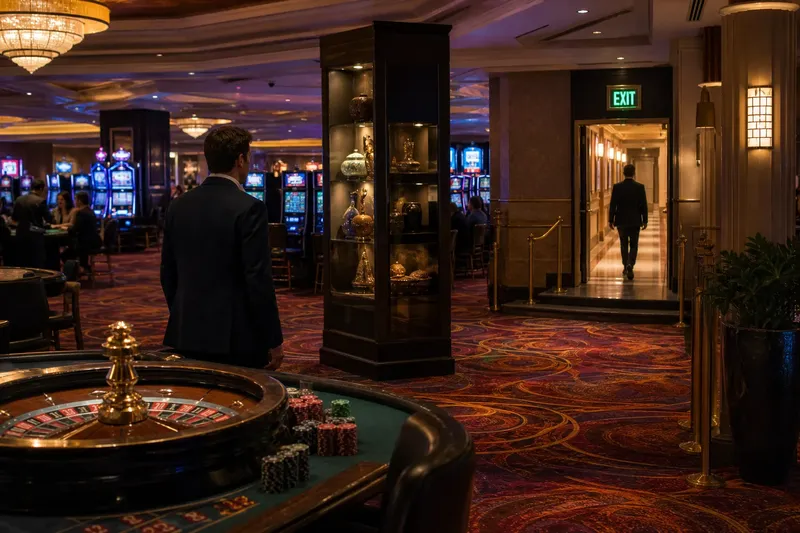
Imagine a fictional casino scene in which a repeating chime begins while a dealer is speaking. The camera shows a guest looking up, but the announcement that follows is partly covered by music. The viewer can recognize an alert and see that people notice it, yet cannot know the full message. If the scene later includes a clear close-up of a display naming a location, that visual cue supplies context the sound did not carry.
Timing and overlap
The order of cues changes how a scene feels. A tone before speech can create a pause in which characters notice the change. Speech that begins at the same time as the tone can feel urgent, but the overlap may make the words less legible. An announcement that comes later can seem like clarification, though the viewer should not assume that every real system uses the same sequence.
Repetition matters, too. A recurring tone can hold attention after the first burst, while a spoken message may be delivered once or repeated. If a scene cuts between different parts of the casino, the sound may remain continuous even as the characters’ access to the message changes. A viewer can ask: Is the tone audible across the scene? Do the words reach the people shown? Does the edit make the audience hear more than any one character could?
Silence is also a storytelling cue. If the alarm stops but characters continue to react, the scene may be showing that the event remains unresolved. If speech continues after the tone fades, the words may be the information the director wants the audience to retain. These are interpretations of editing and sound design, not dependable signals about real conditions.
What does each cue tell you?
What does an alarm tone communicate?
It communicates that an alert is being made and draws attention to a change. By itself, it may not identify the cause, location, or intended action.
What can a spoken message add?
Speech can give names, context, or directions that a tone cannot encode in words. Its usefulness in a scene depends on whether the wording is audible and complete.
Why might characters miss an announcement?
Music, conversation, distance, and overlapping sound can obscure speech. A scene may also show a character distracted or positioned away from the apparent source.
Does a dramatic tone identify a real alarm?
Not necessarily. Film and television may alter, invent, or emphasize sounds to serve the story, so a dramatic cue alone cannot establish what a real system is signaling.
Reading the scene fairly
When comparing the two cues, separate what the sound tells you from what the words tell you. Note whether the tone repeats, whether speech follows, and which characters seem to hear each layer. Then distinguish what the scene confirms from what it leaves uncertain.
- Listen for the cue: Is it a bell, horn, chime, or electronic pattern?
- Track the timing: Does speech begin before, during, or after the sound?
- Check the wording: Can you make out a location or other specific information?
- Watch the listeners: Do their expressions or actions suggest that they heard the cue?
- Notice added context: Does a display, staff member, or change in the setting clarify what the sound cannot?
These questions help keep interpretation grounded in what appears and sounds on screen. They also prevent a common leap: assuming that a tone has one universal meaning or that a spoken announcement is automatically understood by everyone in the room.
When cues disagree
A scene can make the two signals seem to conflict. The tone may continue while a voice gives an apparently reassuring message, or the announcement may describe one area while characters elsewhere react. That mismatch can reflect distance, editing, confusion, or a plot decision. It may also be intentionally unclear because the audience is meant to share the characters’ uncertainty.
Look for the source of each piece of information. Is the message coming from a ceiling speaker, a phone, a staff member, or a character repeating what they heard? Does the scene identify where the tone originates? A character’s interpretation is not the same thing as a confirmed announcement. Treating those sources separately makes the scene easier to follow without inventing missing details.
For casino fire-safety literacy, the useful distinction is simple: an alarm sound attracts attention, while a spoken message can supply language and context. The next time a scene pairs them, listen for what the tone establishes and what the words actually add. That small separation helps you read the storytelling more precisely—and leaves real-world decisions to the appropriate venue information and trained personnel.