How to Read an Exit Route in a Casino Scene
Learn how to read an exit route in a casino scene by tracing the character’s movement, reading signs and landmarks, and naming what the camera leaves unseen.
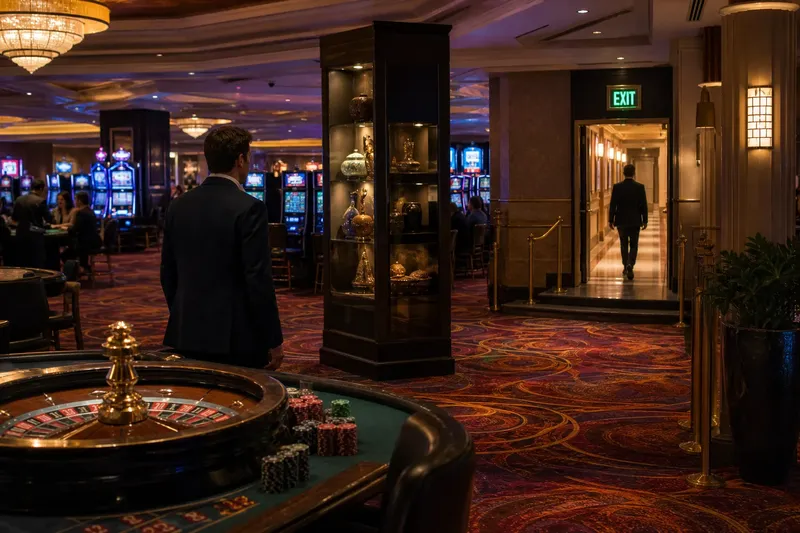
The most common mistake when reading an exit route in a casino scene is assuming a visible exit sign tells the whole story. It may identify a direction, but it cannot show whether the people on screen can reach the door or where it leads. To assess an exit route in a casino scene, follow the character’s movement through the space rather than treating the sign as the subject.
This is a way to describe a film, not to judge a real building’s compliance. In an emergency, follow posted instructions and staff directions, and use a route that appears safe and available.
Follow character movement
Start with the character’s location and track each visible change: leaving a table, crossing an aisle, passing a landmark, and reaching a door. A cut can skip routine movement, but the shots should still give the viewer a sense of direction. Note where that sense breaks.
Casinos often have visually busy interiors. Slot banks, gaming tables, queues, columns, and decorative partitions can help establish a location, but they can also make a route hard to read. Ask whether the character passes a recognizable feature or whether the camera’s angle changes so much that the next space is difficult to place.
Think of the sequence like following a line on a map: each turn needs a connection to the next. The film need not show every footstep, but it should give enough visual information to explain how one space leads to another.
Read signs and landmarks
Signs, lighting, floor changes, and distinctive fixtures can orient viewers. Their value depends on timing. An exit sign shown before a character chooses a direction can help explain that choice; the same sign shown only after the character arrives may not clarify how the character got there.
Separate what a cue indicates from what it cannot establish. A sign can point toward an exit, while a landmark can help viewers recognize a corridor. Neither shows on its own that the intervening path is open or that the exit leads to a particular destination.
Also consider what the frame hides. A column may block the approach, a display may obscure a sign, or glare may make a doorway difficult to distinguish. If a later shot reconnects the spaces, describe that visual bridge. If it does not, say what remains unclear instead of filling the gap with an assumption.
Describe the destination
Passing through a door does not identify what is on the other side. A following shot might establish a corridor, stairwell, lobby, or exterior area. If the film cuts to a bright room without enough context to identify it, call the destination unspecified.
Use precise language. “The character follows an exit sign toward a door” describes visible action. “The route leads outside” is justified only if the scene establishes an exterior destination. This distinction keeps a viewer’s account tied to what the sequence actually communicates.
For a real venue, a film scene is not a substitute for its posted evacuation plan or directions from staff. The appropriate route depends on the building and current conditions; follow the venue’s instructions rather than inferring a route from a screen.
Questions about casino routes?
Does an exit sign show the full route?
No. It can indicate a direction or location, but it does not show the character’s entire approach or establish what lies beyond the door. Describe the sign as a cue, then account separately for the movement the scene shows.
Can an edit skip part of the route?
Yes, if the remaining shots preserve enough direction and location for viewers to understand the connection. If a character disappears in one place and reappears elsewhere with no orienting cue, describe the missing link rather than inventing one.
What should viewers call an unclear destination?
Call it unspecified unless a shot or clear visual cue identifies the next space. A bright frame or open doorway alone does not establish that the character has reached the exterior.
How can a viewer describe a blocked approach?
Name the visible obstacle, such as a column or partition, and say whether another shot reconnects the character to the door. If no shot supplies that link, describe the approach as obscured rather than claiming the route is passable.
Work through a scene
Say you are reviewing an invented casino scene. A character begins beside a roulette table, sees an exit sign above a doorway across the gaming floor, and moves behind a tall display. The camera then cuts to the character in a corridor, with no view of the doorway or intervening movement.
First, record the starting point: beside the roulette table. Next, note the cue and direction: the sign points toward the doorway across the floor. Then record the obstacle: the display hides the character’s approach. Finally, note the new location: a corridor, whose connection to the doorway is not shown. The resulting description is that the scene establishes a direction and later shows the character in a corridor, but leaves the passage between those spaces unclear. It does not establish whether the door leads outside.
Use these observations to decide how much the scene supports:
- Observation: The character moves from a gaming area toward a sign in connected shots. If the direction stays consistent, describe that movement as traceable; if it changes without a visual cue, note the unexplained shift.
- Observation: The sign appears before the character chooses a turn. If it identifies the direction taken, describe it as an orienting cue; if it appears afterward, do not use it to explain the earlier choice.
- Observation: A column or display blocks the approach. If a later shot reconnects the character to the door, describe that link; if not, say the approach is obscured.
- Observation: A cut follows the character entering a doorway. If the next shot identifies a corridor, stairwell, or exterior, name that destination; if not, call it unspecified.
- Observation: Smoke, glare, or flashing lights make a sign harder to see. If another landmark clarifies the direction, describe that cue; if none does, state that the direction is difficult to identify.
- Observation: The scene shows a door but no movement or landmark connecting it to the occupied area. If a later shot supplies the missing connection, describe that transition; if not, say the route to the door is not established.
When describing an exit route in a casino scene, name the character’s starting place, the cues that guide movement, and the destination only when the film establishes it. That keeps the account focused on how the sequence uses space, not on guesses about a building. In a real casino, take note of posted exit information and follow staff directions rather than relying on a route inferred from a film.