The Empty-Floor Fallacy in Casino Fire Scenes
Learn how casino fire scenes frame crowd movement, spot merging paths and pauses, and tell when an open-looking floor may hide a bottleneck.
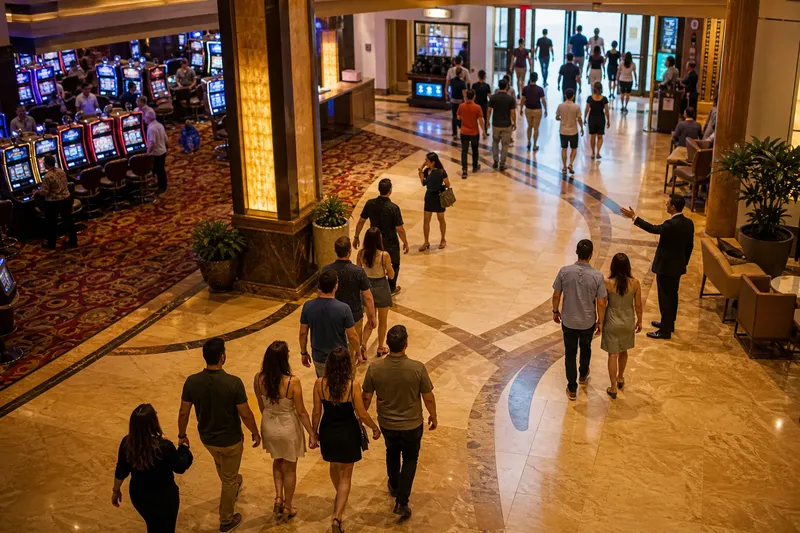
The most common mistake in reading a casino fire scene is treating visible floor space as proof that people can move through it easily. Casino crowd movement can change when separate groups meet, even if the floor looks open in a wide shot. That mistake turns the people in the scene into scenery instead of showing how their paths interact.
To read the movement, track what people do: where they approach one another, when they pause, and whether they change direction. A crowd is less like marks on a floor plan and more like grocery carts meeting at the end of an aisle: each one has room until their paths converge.
Open Floor And Flow
A broad patch of tile is not necessarily a clear stream of movement. Guests may approach a doorway from separate aisles, pause as they merge, or change pace when another group crosses their path. The room’s shape matters, but so do the choices people make within it.
For example, picture two groups walking toward the same doorway, one from a gaming area and another from a nearby lounge. If both turn toward the entrance at once, the observable result may be a pause or a shift in direction as they meet. The open floor has not changed; the paths have.
People And Shared Paths
People alter a crowd’s movement by stopping to find companions, looking toward staff, or reacting to an announcement. A person who pauses can affect those behind them, while a crossing group can redirect people who were moving steadily.
For an invented scene, say six guests are walking toward a doorway and one stops to look for a companion. The others behind that guest slow or move around them; the visible result is a brief break in the stream. If the companion appears from a side aisle, the group may then turn together, changing the direction of people nearby.
Reading Casino Crowd Movement
- Approaching groups: If separate groups head toward the same opening, watch for a pause or a turn; if their paths stay apart, note that the scene shows no meeting at that moment.
- Stopped guests: If someone stops in the path, look for people behind them to slow or move around; if the stream continues, look for an open path around the person.
- Crossing traffic: If one group crosses another’s route, track any hesitation or change of direction; if they do not meet, follow each group separately.
- Staff cues: If people respond to a staff member’s gesture, note which way they turn; if they do not respond, do not assume they saw or understood the cue.
- Companions: If guests pause to look for someone, watch whether the people behind them slow; if the group stays together and keeps moving, track its path as one stream.
- Doorway approach: If people converge at a doorway, look for a change in pace or direction; if they approach separately, note whether the scene shows them merging or continuing apart.
Questions About Crowd Movement?
Why can an open floor still interrupt movement?
People may approach from different directions, stop to find companions, or cross one another’s paths. Those actions can interrupt a stream even when the visible floor is clear.
What changes crowd movement in a casino scene?
Pauses, shared doorways, crossing groups, and reactions to staff cues can all alter how people move. Watch what guests do and how others respond, rather than treating the room as empty space.
How can I tell when groups are merging?
Follow each group’s direction and look for a pause, a turn, or a change in pace where their paths meet. If their paths remain separate in the scene, there is no visible merge to describe.
Should a film scene guide a real evacuation?
No. A dramatic scene is not an emergency plan. In a real emergency, follow posted directions and instructions from staff or emergency personnel.
Observed Movement And Safety
When reading casino crowd movement, describe the actions visible in the scene: groups approaching, guests pausing, or people changing direction. This keeps the analysis focused on how people affect one another, rather than treating an open-looking floor as evidence of an easy route.
For real fire safety, use the building’s posted evacuation information and follow staff or emergency personnel instructions. A scene can help viewers notice how shared paths affect movement, but it cannot replace guidance for the specific building.